UCP and B2B processes: why the future of commerce requires integrated platforms
UCP (Universal Commerce Protocol) is a protocol that enables AI systems to purchase products and services by querying APIs and business processes directly.
19/02/2026
Piero Pescangegno
Chief Operating Officer
#.onePlatform
Food & Consumer Goods
, Retail
, Fashion
Sectors
Sales, Tech
Categories
What is UCP (Universal Commerce Protocol)?
UCP is a communication standard designed to allow AI agents to search for, evaluate, and purchase products and services by querying APIs, structured data, and a company’s business rules directly.
Unlike a marketplace or an e-commerce platform, it doesn’t introduce a new sales channel. Instead, it defines how commerce systems interact with AI—enabling machine-to-machine transactions in the era of the agentic economy.
In B2B, this is a fundamental shift: buyers’ AIs won’t browse web pages. They will analyse data models, contractual terms, and automatable processes to make decisions and trigger orders.
Why was UCP created?
Unveiled by Sundar Pichai at NRF 2026 in New York, the Universal Commerce Protocol was created to make commerce globally interoperable in the age of intelligent agents.
Developed with partners such as Shopify, Etsy, Wayfair, Target, and Walmart, it is compatible with leading agent protocols and payment systems.
Like HTTP for the web, UCP establishes a shared standard. Its goal is to make products and services purchasable directly within AI-driven conversational experiences—through standardised, machine-readable integrations.
The real risk for B2B today
This protocol can apply to B2B too – with important differences – because business-to-business transactions are business-critical, recurring, highly complex, and governed by customer-specific terms. What’s certain is that more and more B2B buyers will use intelligent assistants to shortlist suppliers, compare offers, and manage automated reordering. The implication is clear: if you’re not readable by AI, you won’t make it into the decision-making process.
The risk isn’t selling less because the market changes- it’s not being evaluated at all by the AI tools buyers use. It’s a silent risk: it won’t show up in your KPIs, it won’t trigger complaints, but it will erode market share over time. A buyer won’t call to tell you their AI is excluding you because your product data isn’t machine-readable. They’ll simply buy elsewhere.
The winners will be the companies able to expose data, rules, and processes in a structured, interoperable, and governable way. UCP is the enabling infrastructure for this scenario, while integrated, process-oriented platforms become the strategic asset to stay relevant, chosen, and competitive in the age of the agentic economy.
From “channel-driven” B2B to “process-driven” B2B
Today, B2B companies invest in e-commerce portals, customer areas, and apps. These tools are human-facing interfaces and will remain essential assets for managing human-to-human commercial relationships. The difference is that these interfaces won’t be used only by people anymore.
AI doesn’t browse pages: it queries processes, interprets relationships, and scans data tables to find the information it needs to achieve a goal.
Interface usability will still be necessary – but it will no longer be enough to ensure process effectiveness. It must be matched by strong data-model design and architectural quality. In other words: how easy is it for an AI to understand your offer and buy it?
In this new landscape, the winners are those who expose, clearly and reliably, complete and standardised product data, codified commercial terms, explicit sales rules, and order processes that can be automated.
Why PIM, CRM and B2B e-commerce are central in the UCP era
This means that PIM, CRM and B2B e-commerce systems are no longer just essential operational tools – they become strategic assets for staying relevant in an agentic economy.
A PIM becomes the place where attributes, variants, certifications and logistics constraints are made machine-readable. The critical constraint is simple: if product data isn’t structured, AI won’t consider it.
In B2B, CRM has traditionally been the memory of relationships. With UCP, it also becomes the memory of rules, exceptions and customer priorities. The constraint here is just as clear: AI buys by applying procedures that must be defined upstream, codified, and applied to properly segmented customers.
Sales teams won’t disappear, but they will evolve: less order entry and manual follow-ups, more rule configuration and exception management. The shift in perspective is substantial: value no longer lies in manual execution, but in the governance of automated processes.
.one: a platform that’s already UCP-ready
In this scenario, .one comes with a structural advantage. As an integrated platform that brings together CRM, PIM, B2B e-commerce, processes, data and rules within a single architecture, it enables unified and structured data, codifiable business logic, end-to-end traceable B2B processes, native integration across product, customer and sales, and APIs designed for interoperability.
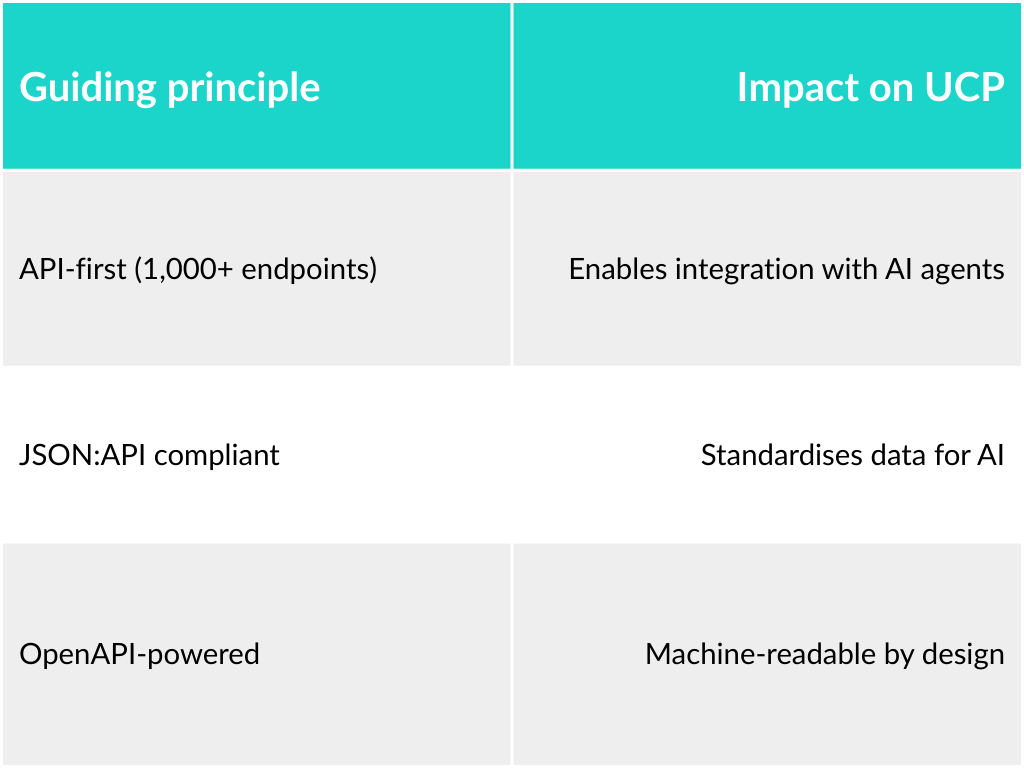
The .one architecture was designed around 3 guiding principles:
These three characteristics make .one UCP-ready because they go straight to the heart of what matters when the “buyer” becomes an AI agent: integration, machine-readability, and API-driven execution.
A broad, flexible API library means an agent can not only read data, but also perform concrete actions (transactions, CRUD operations, reporting) without relying on human-facing interfaces.
JSON:API compliance adds a decisive advantage: data and relationships are exposed in a standard, predictable way, with consistent error handling—reducing ambiguity and making automations, filtering, pagination and queries more reliable.
Finally, an OpenAPI foundation makes the system discoverable and self-describing: an agent (or a developer) can quickly understand what it can do, how to do it, and under which constraints – speeding up integration and reducing friction.
A process-oriented integrated platform like .one is necessary – but not sufficient
To be truly “UCP-ready”, APIs and an excellent data model aren’t enough. Data and commercial rules must also be semantically clear and machine-executable (customer terms, policies, logistics constraints, priorities, exceptions), and there must be a layer of higher-level actions that turns 1,000 endpoints into simple operations for an agent (e.g. “create order”, “apply contract”, “check availability”).
This is also part of what we do: guiding customers in designing and implementing the right solution, supported by an in-house delivery team that understands segment- and market-specific commercial best practices, and is involved from the very first phase of analysis and functional requirements definition.
We’re living in an era of extraordinary opportunities (for those ready to seize them)
UCP doesn’t describe a distant future – it describes how B2B purchasing decisions will be made over the next few years. Companies investing today in processes, data and integrated platforms are building the infrastructure that will make them visible and competitive in a market where data clarity matters as much as the quality of the offer.
RetAPPs joins the Aton Group: supermarket shopping gets smarter
22/09/2026
Learn more
Food & Consumer Goods · Sales·Tech
Alice Cavedoni
In Food Service, a B2B portal can be much more than just an ordering channel.
18/09/2026
Learn more
Food & Consumer Goods · Sales·Tech
Alice Cavedoni
In Food Service, how well do you really know your customers?
18/09/2026
Learn more
People·Tech
Giorgio De Nardi
AI and work: who is really at risk in the algorithmic revolution
01/09/2026
Learn more
Food & Consumer Goods · Sales·Tech
Alice Cavedoni
PPWR and the food sector: what changed from 12 August 2026 for packaging compliance
01/09/2026
Learn more
Food & Consumer Goods · Retail · Tech
Nicolò Venchierutti
GS1 Sunrise 2027: towards the digital twin of the consumer product?
30/07/2026
Learn more
CASE STUDY
Here are some of our experiences
Read
Amadori
Food & Consumer Goods
In the fresh produce sector, timeliness is essential to ensure quality and safety for consumers. Amadori, a benchmark brand in the Italian agri-food industry, faces the daily challenge of distributing…
Discover more
Read
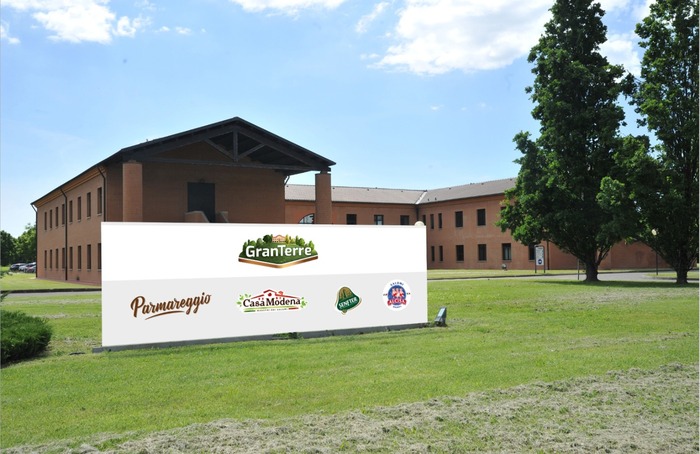
GranTerre
Food & Consumer Goods .one PIM
How can you manage and enhance an information asset made up of tens of thousands of items, while at the same time involving a wide range of internal and external…
Discover more
Read
Caffè Vergnano
Food & Consumer Goods
Today Caffè Vergnano is present in 19 regions with more than 4,500 Ho.Re.Ca. customers and worldwide with more than 70 locations in 19 countries. Such an extensive sales network…
Discover more
Read
Gruppo Poli
Retail Vendite Omnichannel
Poli has combined tradition and innovation in its way of doing business with a focus on employees, customers and the local area. In Aton, it has found a…
Discover more
Read
Cattel
Food & Consumer Goods Vendite Omnichannel
Cattel S.p.A, a leading company in Northern Italy in the distribution of food products in the Ho.Re.Ca channel has profoundly transformed the order collection by adopting the Aton .onSales B2B solution.
Discover more
Read
Faster
Industrials Supply Chain Solutions
All projects, whether successful or not, have stories to tell. A difficult uphill start, a start full of hope, repeated twists and turns where the viewer is swept away by…
Discover more
Read
Moncler
Fashion Service Desk
Aton ServiceDesk is also behind the scenes in the first Boutique entirely dedicated to the Moncler Enfant collection, opened at the historic premises in Milan, Via della Spiga 7, which has been…
Discover more
Read
Rana
Food & Consumer Goods Omnichannel Sales
A real-time photography of the Mass Market Retailers’ world to measure Trade Marketing activities efficacy in points of sale in Italy, France and Spain: with this target in mind, Aton,…
Discover more
Read
Procaffè
Food & Consumer Goods Omnichannel Sales
Procaffè, historical coffee roasting company born among the Belluno Dolomites and best-known by its brands Bristot, Testa Rossa, Breda and Deorsola, has decided to undergo – together with Aton – a growth course aimed…
Discover more
Read
Fassa Bortolo
Industrials Omnichannel Sales
The application enables Fassa Bortolo’s agents and head office staff to consult and manage all the key information for handling customer relationships directly on iPad. In addition to traditional…
Discover more
Read
Granarolo
Food & Consumer Goods Omnichannel Sales
Granarolo, the country’s largest agro-industrial group with Italian capital, through its subsidiary Zeroquattro S.r.l., has embarked on a path of innovation in its sales channels that involves thousands of users…
Discover more
Read
Ica System
Food & Consumer Goods Omnichannel Sales
Also in the world of products for professional cleaning is gaining ground B2B e-commerce, a web portal that simplifies and quickens purchase management and controls open entries, order history and technical and…
Discover more
Read
Kering Eyewear
Fashion Omnichannel Sales
For brands operating in the eyewear world, protagonists these days at the MIDO, the greatest internatinal event for the eyewear industry (Milan, 24th-26th February), wholesalers’ sales and…
Discover more
Read
Salewa
Fashion Service Desk
A single point of contact and responsibility to which refer for any criticality related to hardware and software infrastructure management.
Discover more
Read
Bindi
Food & Consumer Goods Omnichannel Sales
The introduction of a next-generation tablet order-taking app enables sales reps at Gruppo Bindi – a family-run premium pastry company serving the Ho.Re.Ca sector since 1946…
Discover more
Read
Poltrona Frau
Fashion Supply Chain Solutions
Roberto Boselli, CIO & Communication Manager at Poltrona Frau, presents the leather traceability project developed with Aton at the annual European event on RFID: RFID Journal…
Discover more
Read
Segafredo
Food & Consumer Goods Omnichannel Sales
Segafredo Zanetti & Aton together towards 4.0 sales solutions The quality of a product like coffee, which we drink every day at a bar or at home, is the…
Discover more
Read
Camon
Food & Consumer Goods Omnichannel Sales
The adoption of a sales force automation solution on tablets and smartphones has provided Camon with a new sales model, characterised by greater interaction between the…
Discover more
Read
Despar
Retail Omnichannel Sales·.onRetail
Increasingly Smart Despar Stores: in a Video, Workers Explain How an App Can Improve Everybody’s Work
Discover more
Read
Safilo
Fashion Vendite Omnichannel·.Sell out Service
The eyewear industry moves fast: its global value is around $220 billion and continues to grow at more than 10% per year. In this market,…
Discover more
Read
Unicomm
Retail Vendite Omnichannel
Over its nearly 70-year history, Unicomm has grown to be present today in 7 regions and 32 provinces in Italy. With more than 1,500 devices in the…
Discover more
Read
Hausbrandt
Food & Consumer Goods Vendite Omnichannel
Today, the aroma and fragrance of Hausbrandt coffee are recognised in over 70 countries worldwide. The Zanetti family’s passion goes even further, extending into the world of beer with…
Discover more
Read
Tecnica
Fashion Vendite Omnichannel
Everyone will remember the arrival of carving skis and how this innovation made life easier for many skiers – and completely changed it for others… In the world of sales…
Discover more
Read
G&P Net
Fashion Soluzioni per la Supply Chain
G&P Net (brands Peuterey, Geospirit) developed an RFID project together with Aton to fight the grey market – a phenomenon less well-known than the black market, but more complex, involving…
Discover more
Read
Viridea
Retail
What are the key elements of a retail management application? As we have already seen in the large-scale retail world, in cases such as Unicomm and…
Discover more
Read
Stroili Oro
Fashion Vendite Omnichannel
Stroili Oro, a leading Made in Italy brand with 400 directly owned stores, has adopted a tablet-based sales management solution for its agents operating in the Italian, French and…
Discover more
Read
Dac
Retail
Companies operating in the Food Service Industry often need to reorder products in a prompt and autonomous way, 24/7, from devices like smartphones and tablets, starting from a customised assortment with…