Aton at the Brussels Dialogue: the future of mission-driven companies
02/10/2026
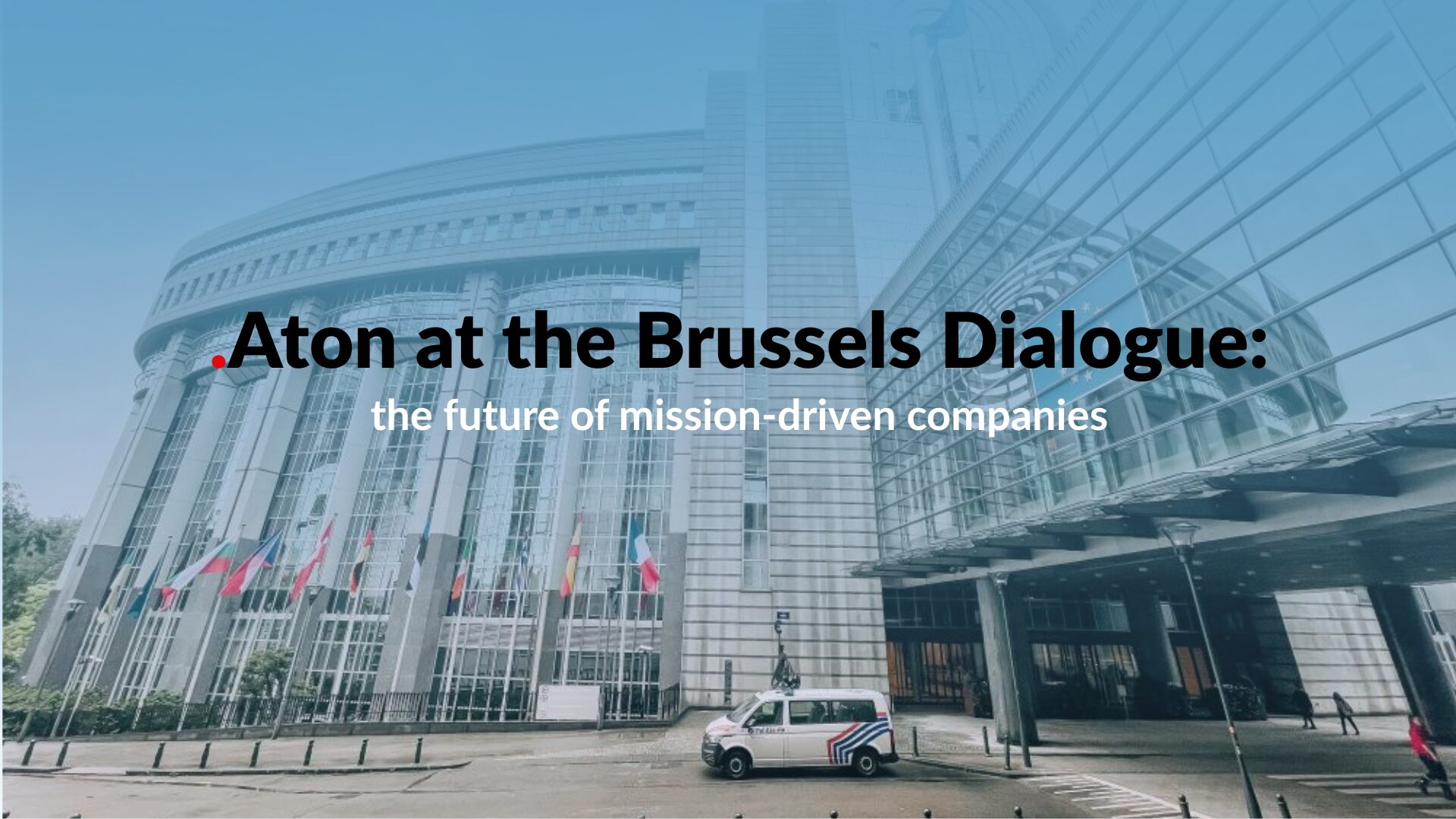
On 15 July 2026, the first edition of the Brussels Dialogue on Mission-Driven Companies took place at the European Parliament in Brussels: an international dialogue bringing together businesses, institutions, academia and stakeholders from Europe, the United States and Latin America to explore the role of companies that choose to integrate economic, social and environmental goals into their business models.
The initiative was promoted by Mariangela Zito, employment lawyer, academic researcher and one of the founders of ConfBenefit, the International Confederation of Benefit Corporations established in Brussels to promote, on a global scale, business models capable of combining economic growth, competitiveness, innovation and positive social impact.
As a Benefit Corporation, Aton followed this European dialogue with particular interest. We asked Mariangela to tell us how the project began, what its objectives are and why forward-looking companies should pay close attention to its development.
My interest grew out of the intersection between employment law, business and governance. As an employment lawyer, I have always looked at companies not only as economic organisations, but also as places where balances, responsibilities and relationships between different interests are shaped.
From this perspective, it was natural for me to explore business models that seek to embed these issues directly into governance, moving beyond the idea of sustainability as something external or purely reputational. I find this particularly interesting from a professional perspective too, because when purpose genuinely becomes part of a company, it inevitably affects the organisation, its people, decision-making processes and relationships between different stakeholders.
This is where Benefit Corporations, Italian Società Benefit, SBICs, Latin American BICs, Entreprises à Mission and other models emerging across different legal systems come into play.
What I find most interesting is the common question behind all these experiences: how can a company embed economic, social and environmental objectives into its governance over the long term, while remaining competitive and continuing to create lasting value?
ConfBenefit was born from this question. The Confederation was founded in Brussels by a group of companies operating directly within these models, which recognised the need to create a cross-border and cross-sector space for dialogue, bringing together different experiences, legal frameworks and practices.
The main objective is not to identify a single model that works for everyone, but to create the conditions in which different experiences can be compared, understood and brought into a more structured European and international dialogue.
Europe certainly does not lack innovation, and there are already many interesting models at national level. What has been missing until now is a permanent European space where these different experiences can meet, be compared and build shared knowledge.
That is why we launched the Brussels Dialogue on Mission-Driven Companies. Its first edition took place at the European Parliament and brought together institutions, businesses, academics and stakeholders from different geographical regions.
We deliberately chose the expression “mission-driven companies” as a common language, not as a new legal category. The aim is not to replace existing national models, but to create common ground for dialogue between them.
Three main issues emerged during the first meeting. The first concerns the contribution these companies can make to European competitiveness and long-term value creation. The second concerns what Europe can learn from the diversity of existing models, including those outside the European Union. The third concerns how we can move from fragmented national experiences towards a more structured European dialogue.
For me, the most important outcome was that the discussion did not remain at the level of sustainability in the abstract. We talked about governance, talent attraction, competitiveness and resilience, access to investment, innovation, accountability and regulatory quality.
This issue is not limited to companies that have already adopted a specific “benefit” or mission-driven status. It is broader, and concerns the way in which companies in general can integrate long-term objectives into their business models. This is why the discussion inevitably intersects with some of the issues currently at the heart of the European agenda, from the future of company law and EU Inc. to access to finance, strategic public procurement and mechanisms capable of rewarding responsible business practices.
The Brussels Dialogue is not a one-off event: it is an evolving process. We have already received positive feedback and expressions of interest in taking part, which confirms the need to give continuity and substance to the dialogue that began in Brussels.
The first objective we have set ourselves is to build a lasting community of stakeholders bringing together European and national institutions, businesses, universities, investors, professionals and civil society organisations.
The second is to produce research and comparative knowledge. There are many valuable experiences that often remain confined to their respective legal systems or even isolated within individual companies. ConfBenefit aims to help gather data, business cases, regulatory experiences and research that can help us understand what really works and under what conditions.
The third objective is to bring the evidence we collect into the institutional debate. We are not starting from the assumption that Europe necessarily needs to adopt a new, uniform corporate model.
First, however, we need to understand which problems we are trying to solve and which tools may be most effective: harmonisation, mutual recognition, common standards, incentives or simply greater cooperation between national ecosystems.
For this reason, the Brussels Dialogue will continue through research, policy dialogue, thematic meetings and international collaborations.
The Brussels Dialogue is not reserved for experts or institutions. On the contrary, it needs above all the companies that live these models every day and can show what it really means to translate purpose into business decisions.
From this point of view, Aton has a great deal to contribute, as we also saw in Brussels. The experience you shared, Stefano, showed very clearly that talking about mission means going beyond statements of principle and asking how work organisation, decision-making processes and the way a company aligns its stated values with everyday practices actually change.
These are exactly the kinds of evidence we are interested in: understanding what really works, which choices create tangible results and where, instead, there is a risk that the model remains purely formal.
For Aton, taking part is also an opportunity to join an international dialogue with companies facing similar questions in different contexts, legal systems and industries. And I believe this is one of the most valuable aspects: helping to build a European debate grounded in real business practice.
And I genuinely hope Aton will continue to be one of the key participants as the Brussels Dialogue develops.
The Call for Evidence is the first step in ensuring that the Brussels Dialogue does not remain a purely theoretical discussion, but continues as an active, open process capable of gathering evidence, identifying good practices and highlighting challenges and possible solutions.
We are looking for business cases, data, research, governance practices, entrepreneurial perspectives, impact measurement tools, challenges encountered when applying different models, investment experiences or perspectives, relationships with public authorities and access to support mechanisms or procurement, as well as examples of what has not worked.
We are particularly interested in contributions from different countries and legal systems, because the value of the Call will lie above all in its comparative dimension.
Companies, managers, investors, academics, professionals, associations and other stakeholders can all take part. We are not necessarily looking for lengthy reports or academic papers: a well-documented business case or a concrete professional experience can be extremely valuable.
The materials collected will feed into ConfBenefit’s future research activities, the work of the International Observatory and the next stages of the Brussels Dialogue.
The idea is simple and ambitious at the same time: before discussing which policies or legal instruments Europe may need, we first have to listen to those who are already putting these models into practice.
Thank you, Mariangela, for your time and for sharing with us the vision driving this ambitious European project. At Aton, we know from experience that innovation, growth and responsibility are not separate paths, but dimensions that strengthen one another when they are consistently embedded in a company’s everyday decisions.
Thank you!
ConfBenefit contact: confbenefit@confbenefit.com
For information about the Call for Evidence: www.confbenefit.com
Mission-driven companies integrate economic, social and environmental objectives into their governance and business decisions. The model is designed to create long-term value for both the company and its stakeholders by translating purpose into processes, responsibilities, impact measurement and operational choices.
The Brussels Dialogue creates a permanent European space for discussion between businesses, institutions, universities and investors. It brings together different national models to gather evidence, share governance practices and contribute useful data on competitiveness, impact and regulation to the European debate.
Purpose becomes tangible when it is embedded in governance, objectives and impact measurement. Aton, a Benefit Corporation since 2021 and a certified B Corp, integrates social, environmental and economic goals into its strategy and uses the B Impact Assessment to evaluate and improve its performance.
Integrating ESG objectives into governance connects sustainability with risk management and long-term value creation. For decision-makers, this means making commitments measurable and verifiable, assessing their impact on stakeholders and processes, and generating useful evidence for accountability, investment decisions and continuous improvement.
The ROI of a mission-driven model should be assessed alongside economic, social, environmental and governance indicators. Structured tools such as the B Impact Assessment help measure effects on workers, communities, the environment, customers and governance, linking business performance with impact over time.