DevFest Venezia: bringing people, technology and new ideas together
13/11/2026
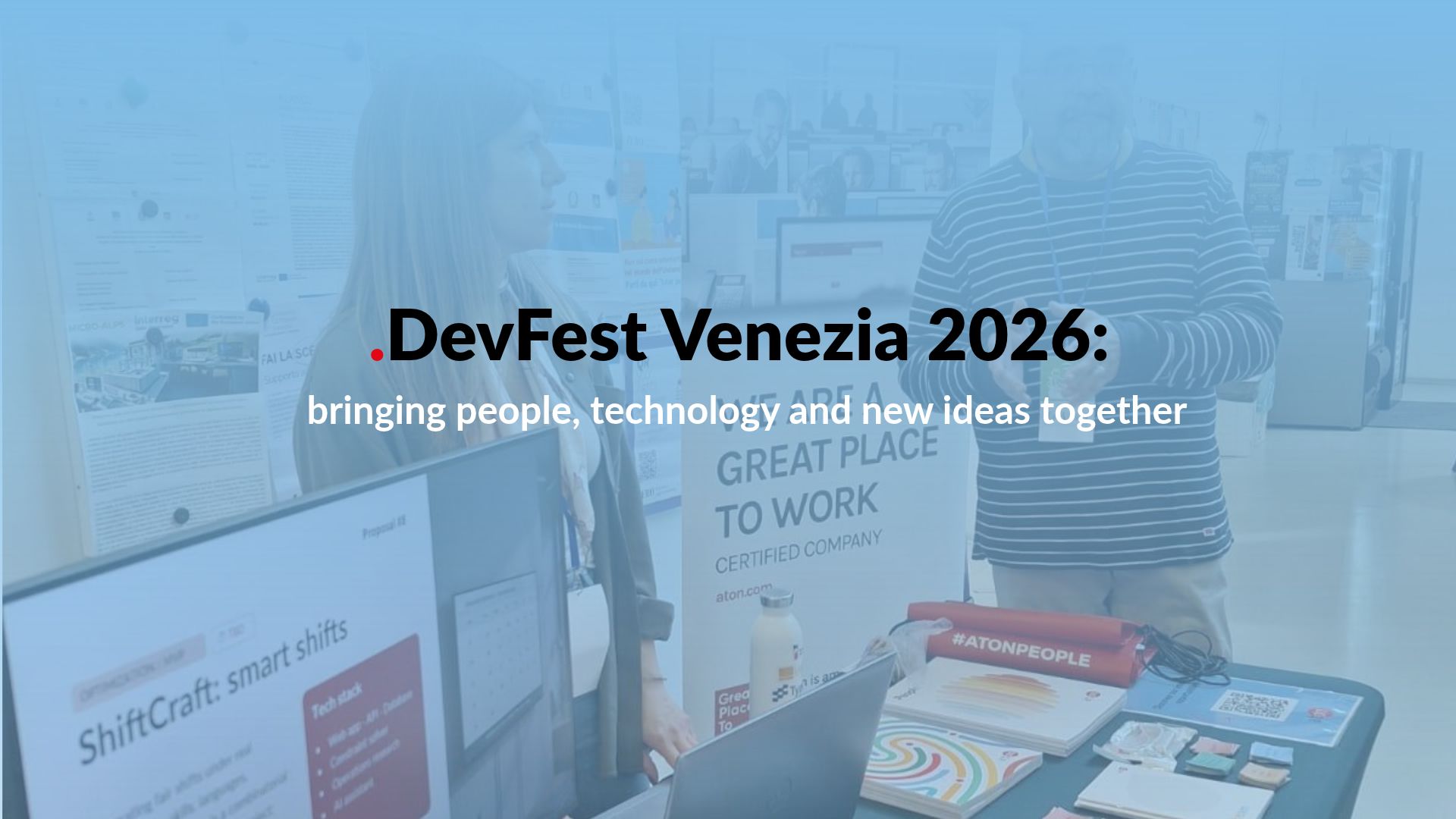
Once again, we attended DevFest Venezia, an event that has become a regular fixture for Aton and many other organisations across the region.
Connection is at the heart of DevFest. Part of the global DevFest network, the event brings international speakers to Ca’ Foscari University’s mainland campus, while remaining firmly rooted in the local community and supporting students and businesses across North-East Italy.
It creates a valuable link between academia and industry, thanks to the collaboration between Google Developers Venezia and Ca’ Foscari University. Students have the opportunity to engage with professionals and businesses, while companies can meet emerging talent and offer them interesting challenges to tackle.
The event also brings together students, local professionals and the wider world of conferences and public speaking. It offers a welcoming environment for those taking their first steps as speakers, while providing an international dimension that makes the experience a valuable addition to their CV.
A few years ago, we thought our way of working at Aton might be an interesting story to share. This year, it was Ceren Özgür’s turn to take the stage, presenting the project she worked on during her internship at Aton.
Internships at Aton are designed around practical needs, with a scope that allows students to achieve tangible results within the time available. The projects offer both an opportunity to explore interesting topics and a chance to make a meaningful contribution to Aton’s work.
Ceren tackled a particularly relevant challenge: how to maintain consistency in development practices and software architectures as the number of projects, technologies and the amount of code increase, partly driven by AI. Take CI/CD pipelines, which automate software integration and delivery. Which projects use them? Where are they missing? Which tools need updating? Checking each repository individually would be time-consuming, so a way was needed to gather this information and assess it against a consistent set of rules.
One option would have been to write a program to perform all the necessary checks. However, as the number of rules increased, so would the amount of code to maintain. Instead, Ceren chose Open Policy Agent (OPA), an open-source policy engine that keeps rules separate from application code. She developed a Python tool that collects information from repositories and passes it to OPA, which evaluates it against policies written in Rego. The result is an assessment of each project’s maturity level, highlighting any missing elements.
During her talk, she also explored WebAssembly as a way to run policies directly within Java applications, without having to manage a separate server. This approach uses predefined rules to deliver verifiable results, without consuming AI tokens. It’s particularly relevant at a time when AI is playing an increasingly prominent role in software development.
By coincidence, the importance of this topic became particularly clear towards the end of the summer, with the introduction of new regulatory requirements for software security and a simultaneous surge in security incidents, some of which attracted widespread public attention.
Last year, Ceren attended DevFest as a member of the audience. It was there that she first met the Aton team, sparking the conversations that would eventually lead to her internship. This year, she returned as a speaker to share what she had achieved.
DevFest also offers an opportunity to reflect critically on our everyday work and discover that something we’ve developed might be worth sharing. Finding a way to communicate it to others is always a valuable exercise, especially when the person doing so was sitting in the audience just a year earlier.
DevFest Venezia is part of the global DevFest community, bringing together students, developers, businesses and international speakers. Organised in collaboration with Google Developers Venezia and Ca’ Foscari University, the event offers opportunities to exchange knowledge, build professional connections and connect emerging talent with businesses.
Open Policy Agent (OPA) is an open-source policy engine that enables organisations to define and enforce rules independently of application code. Using policies written in Rego, it evaluates data from software projects to identify any areas of non-compliance with established standards.
Open Policy Agent performs checks against explicit, verifiable rules, without relying on generative AI models or consuming AI tokens. It is particularly useful for assessing compliance with clearly defined technical requirements, such as the presence of CI/CD pipelines or the use of shared tools and standards.
Compliance checks can be automated by collecting data from software repositories and evaluating it against a shared set of policies. In the project presented by Aton at DevFest Venezia, a Python-based tool retrieves information from repositories and uses Open Policy Agent to check it against predefined rules and identify any missing requirements.
Open Policy Agent enables organisations to apply consistent rules across software projects built using different technologies. By keeping policies separate from application code, it makes compliance rules easier to update and helps assess project maturity, reducing the need to review individual repositories manually.