.one and AI: what is the future of software platforms in the age of artificial intelligence?
In recent months, the evolution of generative AI and AI agents has radically changed the way software can be created. Today, thanks to vibe-coding tools, a single AI agent can generate complete applications from scratch, starting from a natural language prompt.
This scenario raises a legitimate question: if AI can rapidly build custom solutions, what is the role of a platform like .one?
Vibe-coding excels in contexts where rapid prototyping is required—where lightweight applications are enough to cover isolated or temporary use cases, typically with simple UIs and processes.
By contrast, it shows structural limitations when dealing with complex business domains, core enterprise data, rules involving constraints or compliance requirements, and the need for scalability, maintainability and accountability.
In this context, .one should not be seen merely as a set of features, but as a coherent and persistent data model that, supported by a reliable execution layer, provides a structured set of validated business rules.
The complementarity between agents and platforms
A practical example of this concept can be seen in the management of customer and product information. In CRM and PIM contexts, AI can support users by suggesting completions, interpreting free-text descriptions, recognising recurring patterns, and assisting with classification and data enrichment.
However, the real value emerges when these capabilities are built on top of a solid, shared data domain.
In this scenario, .one remains the authoritative source – the place where master data, relationships and validation rules are defined in a clear and persistent way. AI does not introduce new data simply because it seems plausible; instead, it collaborates in improving the quality and usability of data that remains governed and consistent.
In other words, if AI interprets intent, .one executes the business.
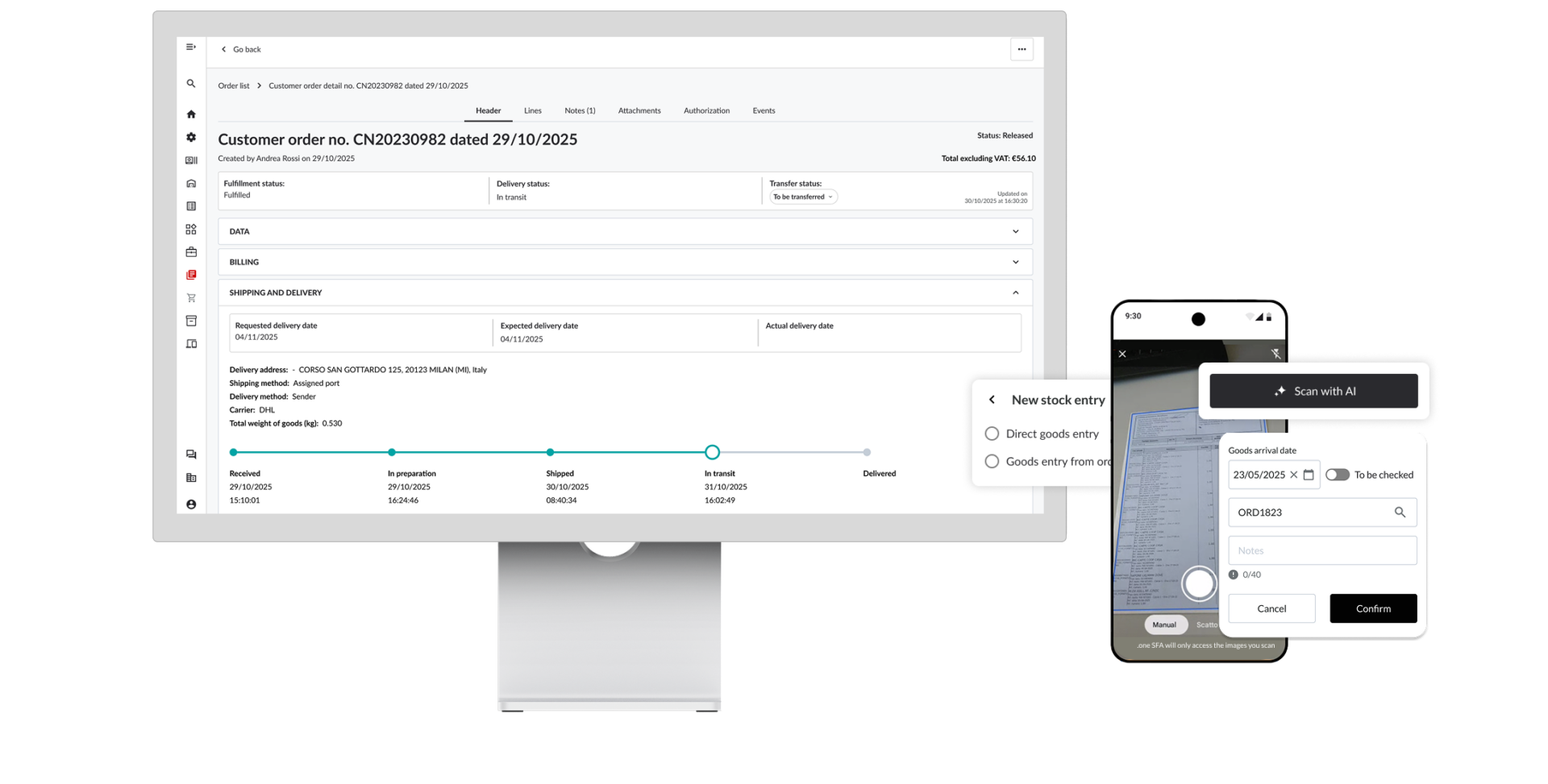
Another concrete example of this complementarity between AI agents and .one is order capture through natural language. In many real-world scenarios, orders are not created within structured interfaces, but arrive as messages, voice notes, emails or even photos of handwritten notes.
In these cases, AI can interpret user intent, extract items, quantities and contextual references, and generate a structured representation of the order. However, .one plays the decisive role when that intent needs to become a business transaction.
Business rules within .one validate items against the customer’s assortment, correctly apply price lists, discounts and commercial constraints, ensure compliance with company policies, and transform the proposal into an official, traceable and governed order.
.one and AI: the central nervous system enhanced by a cognitive front end
On one side, AI accelerates the input of information; on the other, .one ensures its reliability over time.
In this perspective, AI agents become the cognitive front end, capable of understanding natural language, extracting intent and building structured objects.
In a scenario where AI does not replace but complements .one, the platform naturally evolves in three strategic directions:
- .one as an AI-native execution platform: a platform that exposes APIs and services designed to be called by agents, enabling the use of clear, versioned and verifiable domain objects through atomic, traceable and reversible actions. In this context, AI does not “do things” directly – it asks.one to do them.
- .one as a guarantor of consistency and compliance: since AI agents are inherently probabilistic rather than deterministic, .one applies deterministic rules to ensure long-term consistency and protect the organisation from systemic errors.
- .one as a platform that makes vibe-coding safe: paradoxically, this approach allows customers to experiment with AI-generated UIs and build customised micro-workflows – adapting the user experience without putting the business core at risk.
All of this translates into tangible value for the customer: the ability to develop solutions faster, tailor the user experience to specific needs, and maintain full control – relying on a platform built on a solid domain, well-defined and proven rules, and a continuously evolving roadmap.
In summary, .one represents a secure foundation for enterprise AI: AI agents become dynamic user interfaces, while .one acts as the central nervous system.