When we talk about artificial intelligence, the debate often swings between techno-optimistic enthusiasm and fears of widespread job displacement. But when you look at the issue from the perspective of a tech company working every day at the intersection of algorithms and business processes, the perspective shifts considerably.
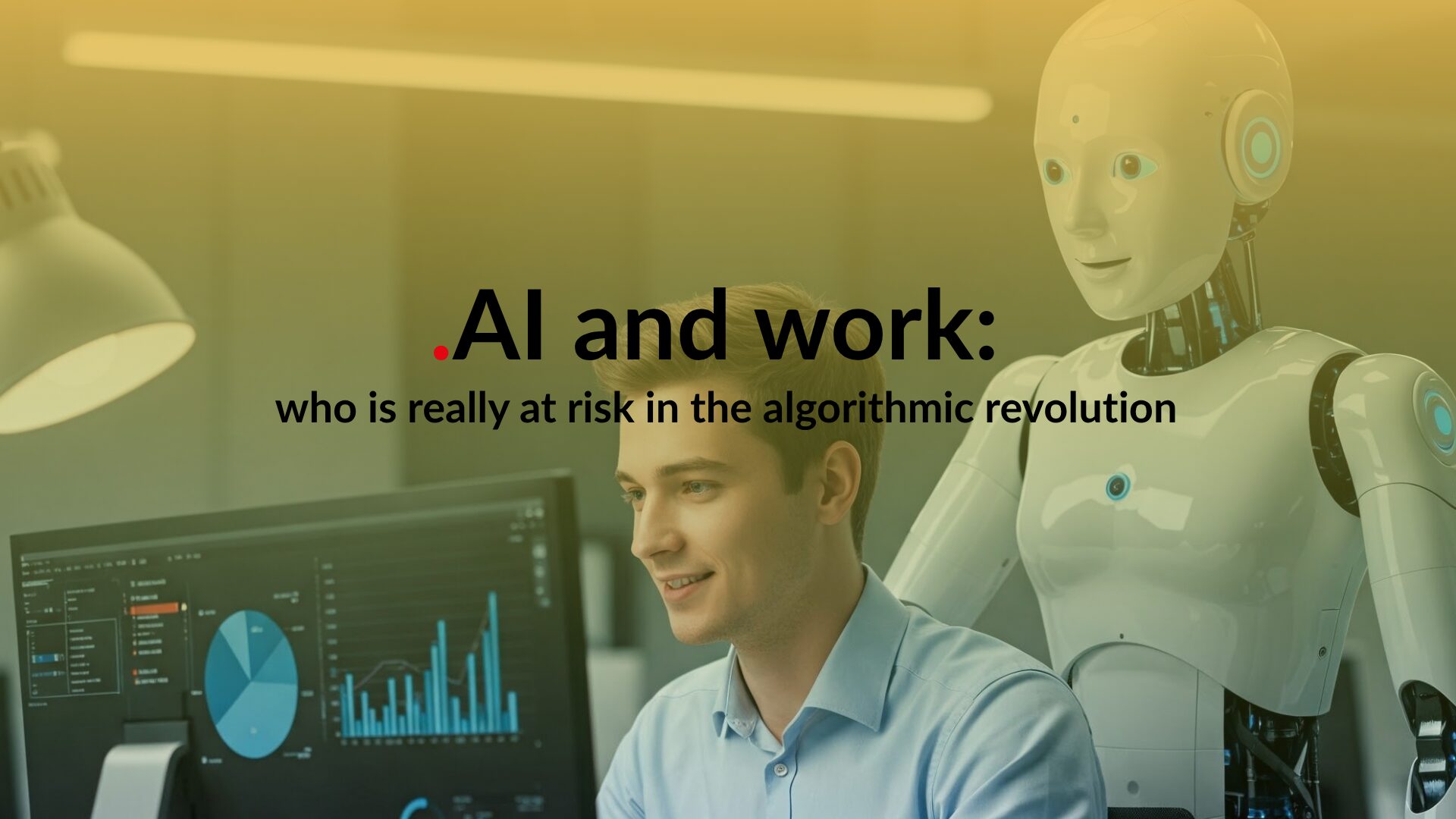
The rise of AI in the labour market can be seen either as a threat to jobs or as one of the greatest opportunities we have ever had to improve the quality of work itself.
The real question is not whether AI will work instead of us, but how AI can help free people from repetitive tasks and put relationships, ingenuity and creativity back at the heart of work.
AI and employment in Italy: the scale of the transformation
We cannot ignore the figures. According to the recent Censis-Confcooperative report “Artificial Intelligence and People: Who Will Serve Whom?”, the impact of the algorithmic revolution on Italian society will be substantial. By 2035, around 15 million Italian workers — roughly a quarter of the entire population — are expected to be exposed to the impact of AI. Of these, around 6 million could see their current roles significantly reduced or disappear altogether.
These figures cannot be overlooked and call for an unprecedented response from both policymakers and business leaders.
However, there is another side to these figures. Around 9 million workers could integrate AI into their roles, shifting their day-to-day work towards more strategic, higher-value activities and away from purely operational tasks. One of the most striking findings, also highlighted by Il Sole 24 Ore, concerns the profile of those most exposed. Unlike previous industrial revolutions, AI exposure is particularly high among middle and upper-middle professional groups, and tends to increase with educational attainment.
The impact of AI on white-collar workers
Today, AI is not primarily affecting workers who perform complex manual tasks in unpredictable environments. It is having a much greater impact on “white-collar professionals” such as accountants, software developers, banking professionals, consultants, economists and insurance specialists. This is a revolution taking place in offices rather than on factory production lines.
Another critical issue that requires careful attention is the impact on gender equality. Because women are statistically less represented in predominantly manual occupations, they may be more exposed to the automation of cognitive and administrative tasks. Without responsible governance, AI could widen the gender gap and undermine decades of progress towards greater equality.
Ethical governance and corporate social responsibility
Corporate social responsibility and sustainability will play an increasingly important role in addressing the imbalances and excesses that may emerge. Business leaders cannot limit themselves to deploying technology simply to cut costs. We all have a responsibility to pursue ethical and transparent governance, while investing significantly in upskilling and reskilling programmes so that people are not left behind: technology should be a means of supporting inclusive, long-term social progress, not simply a tool for maximising short-term profit regardless of the social or environmental consequences.
If governed effectively, AI could become one of the most powerful drivers of productivity ever developed. Estimates suggest that over the next ten years, AI-related GDP growth could reach around 1.8%, generating approximately €40 billion in added value for the Italian economy.
AI and business: from productivity to faster time-to-market
For businesses, this could mean significantly shorter time-to-market and potentially vast new opportunities for growth. By delegating more demanding and repetitive tasks to AI agents — such as summarising large volumes of data or generating basic code — companies can move faster, innovate more frequently and respond to customer needs with a level of speed and personalisation that would previously have been difficult to sustain. AI should not be about taking jobs away. It should be about taking repetitive, low-value cognitive work out of people’s hands, allowing professionals to focus on human relationships, complex problem-solving and creativity.
Knowledge-intensive roles with highly automatable tasks are among those most exposed. Anyone whose role is largely based on repetitive routines, manual data entry, spreadsheets or structured calculations will need to evolve. Professionals such as historians, project managers and executives may increasingly see AI as the ideal “co-pilot”: a tireless digital assistant capable of searching through vast archives, identifying potential budget variances and suggesting possible future scenarios to support real-time decision-making.
The human-centric digital factory
The ultimate goal should be to build a “human-centric digital factory”. In this model, technology does not isolate people. It enables them to contribute more effectively within a working environment that offers greater autonomy and awareness.
An accountant will not necessarily disappear, but may increasingly become a strategic adviser, helping organisations interpret and contextualise data. A software developer will not stop writing code, but may spend more time designing innovative solutions to complex problems while leaving more basic syntax and routine coding tasks to AI agents.
To navigate the age of artificial intelligence, workers will need to adopt a proactive and flexible mindset, treating learning as a continuous process. A qualification can no longer be seen as something acquired once and for all. Regular development, digital certifications and a strong technical and scientific foundation will become increasingly important as the labour market becomes more automated.
Digital skills, adaptability and cybersecurity
Adaptability is becoming a core skill. Courage, curiosity and strong interpersonal skills will help people reinvent themselves throughout their careers. At the same time, professional networking through digital channels is evolving from a simple visibility tool into a strategic resource. Knowing how to use digital platforms and social media effectively will become increasingly important for identifying untapped market opportunities and developing stronger commercial strategies.
Digital awareness and cybersecurity are also becoming fundamental pillars of modern professional life. Protecting data and managing online reputation are no longer secondary concerns. A cyberattack can be more damaging to a business than a natural disaster, potentially threatening its very survival. In this environment, investing in security and digital capabilities is essential both to capture the opportunities created by technological transformation and to strengthen long-term professional and organisational resilience.
AI and work: above all, a cultural challenge
The challenge ahead of us is first and foremost a cultural one. As a CEO, I believe this transition must be led not only with an eye on financial performance, but with the understanding that every line of code should ultimately contribute to improving people’s lives. Artificial intelligence is a mirror of our ability to evolve.
If we approach this opportunity with a strong sense of ethical responsibility, we can build a labour market in which people are no longer simply cogs in the machine, but the ones shaping how technology works and the value it creates.
The question is not whether machines will replace us, but whether we will be bold enough to use them to become more human.