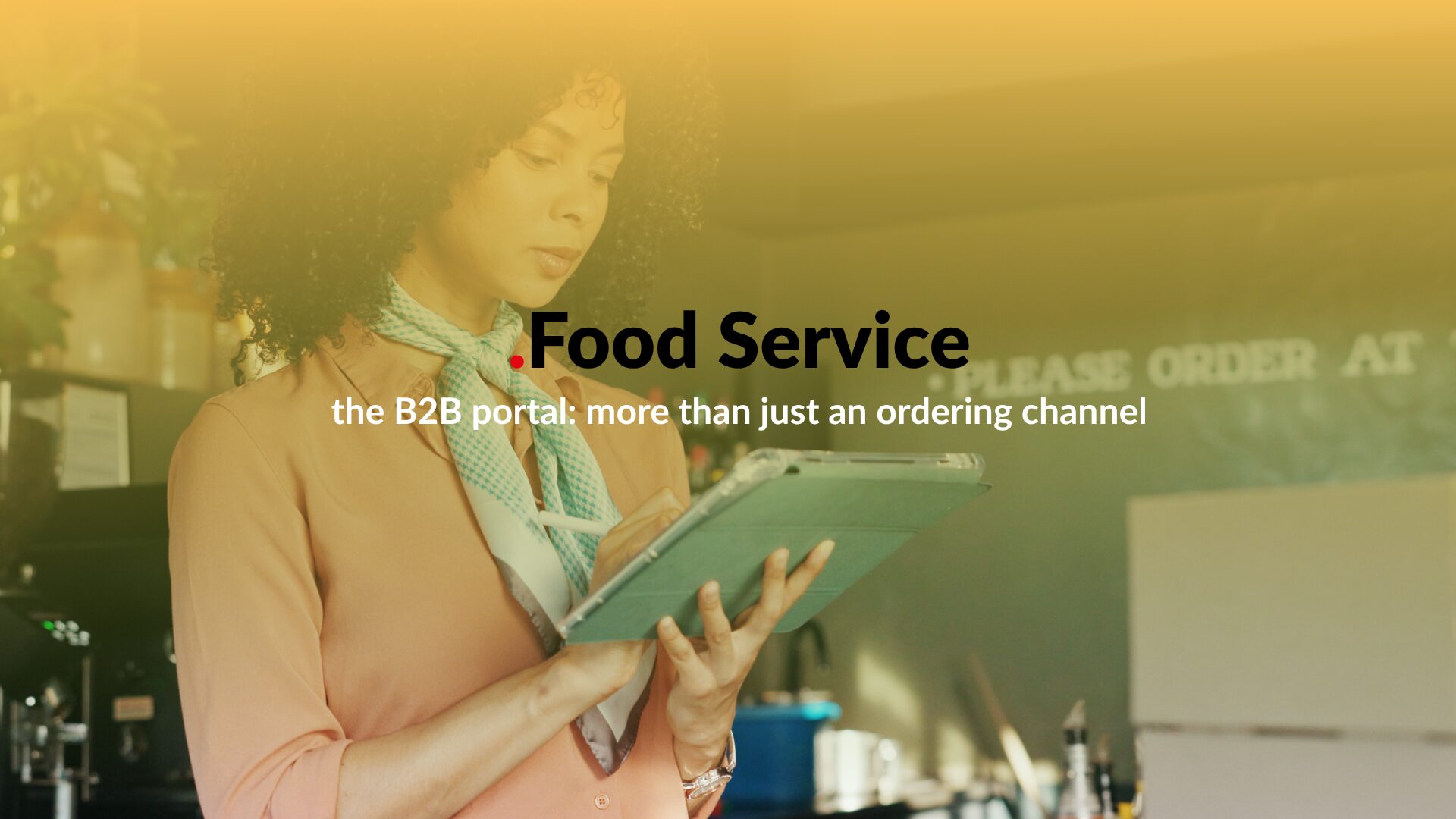
In Food Service, a B2B portal can be much more than just an ordering channel.
18/09/2026
A restaurateur realises on Sunday evening that they need to restock a few products for the week ahead. A hotel prepares its next order after checking stock levels. A regular customer wants to quickly find products purchased recently, check a promotion or retrieve a document.
In all these situations, being able to order online is useful. But if a B2B portal simply replaces phone calls, emails or messages with a digital shopping basket, an important part of the customer experience is still missing.
In Food Service, every customer has a specific commercial relationship with their distributor: they buy certain products, have their own order history, dedicated terms, applicable promotions and established reordering habits. At the same time, they continue to be supported by their sales representative, who knows the business and helps develop the commercial relationship.
The next step for a B2B portal is to bring this knowledge into the digital experience too, so that customers find the same relationship, the same terms and the same level of attention, regardless of the channel they use.
Knowing how much a customer buys is useful. Understanding how their purchasing habits are changing is even more valuable.
A product that used to be purchased regularly but then disappears from orders deserves attention. The same applies to a category that has never been purchased, a drop in order frequency or a significant change in quantities.
These signals can help salespeople understand where to focus during their next visit.
Customer knowledge comes from being able to connect these signals, rather than leaving them scattered across systems, documents and individual memory.
A Food Service catalogue may contain a very large number of products, while each customer usually works with a more limited and specific range.
If customers have to start from the full assortment every time they log in, search for each item individually and rebuild their order from scratch, digitalisation simply shifts part of the workload onto them.
An advanced B2B portal instead starts from the existing commercial relationship, showing:
Reordering therefore becomes simpler, because customers no longer have to recreate their purchasing behaviour every time.
They can start from what they usually buy and explore the wider catalogue only when needed. Recommendations can also highlight products that are relevant to their profile.
The digital experience therefore becomes increasingly relevant: less time spent searching for familiar products, and more room to discover what could add value to the customer’s business.
Promotions are part of the normal commercial relationship between a Food Service distributor and its customers. However, they become less effective when they are separated from the moment when the customer is actually placing an order.
A sales representative may already have discussed a specific offer during a visit, yet the customer may not find it just as easily when logging into the portal. Or an available promotion may remain buried in a separate communication while the customer is selecting products.
Within the portal, this information can become part of the ordering journey itself: the promotion available on a specific product, how much is still needed to reach a threshold, or which terms apply to that particular customer.
The same applies to recommendations. When they are based on purchase history and the commercial information available, they can support customers while they shop without turning the portal into a generic catalogue of suggestions.
The digital relationship with the distributor does not end when the customer confirms the basket.
After the purchase, there are still very practical needs: checking what was ordered, tracking an order, retrieving a previous line item or accessing a document.
That is why purchase history is not only useful for making reordering faster: it is also a record of the commercial relationship.
Orders, line items, discounts, notes and status information can remain available over time.
Within the same private area, customers can also access their commercial and administrative documents, such as invoices, delivery notes, price lists, contracts and financial information.
The portal therefore becomes a single point of access to the information customers need most often, without requiring them to contact the sales representative or back office every time to retrieve data that is already available in company systems.
For distributors, this means giving customers greater autonomy in recurring activities while maintaining service continuity beyond standard working hours and outside direct contact with the sales network.
In Food Service, digital does not replace the commercial relationship.
A customer may reorder their usual products online and speak to their sales representative about a new category. They may receive a proposal during a visit and complete the order later through the portal.
These interactions work better when they are based on the same information.
Customers should find online the same terms and promotions agreed with their sales representative.
Salespeople, in turn, need visibility of what has happened on the digital channel too: the latest order, products purchased, changes in purchasing habits and other information that can help prepare the next visit.
In this way, the portal does not become a parallel channel to the sales representative, but another touchpoint within the same commercial relationship.
Routine reordering, checking order history, reviewing promotions and retrieving documents are all activities customers can manage independently when they have the right tools.
For distributors, this means reducing the operational workload linked to recurring requests.
For sales teams, it means having more time to focus on activities where the relationship really makes a difference: understanding a need, developing a category, winning back a lost product, proposing an alternative or preparing more effectively for a customer visit.
This is where a B2B portal can make a real difference to customer experience in Food Service: by making customers’ day-to-day activities simpler and maintaining continuity across digital channels, back office and the sales network.
” target=”_blank”]
In Food Service, a B2B portal allows customers to manage recurring reorders independently, giving the sales team more time to focus on a consultative relationship. Customers, sales representatives and back-office staff share the same order history, terms and up-to-date information, making the sales process smoother and easier to track.
AI can make a B2B portal faster and more personalised by helping customers find products using natural language and automating repetitive tasks. When integrated with product data and customer profiles, it makes search and reordering easier while keeping information consistent across catalogues, price lists and customer-specific terms.
.one B2B Portal is designed to integrate with ERP, CRM, logistics, payment systems and sales force applications. Orders, documents, prices and terms can therefore remain synchronised across the front end and back-end systems, reducing duplicate data entry, errors and information silos.