Gluten-free, organic, vegan: when the catalogue has many layers and no system to hold them together
02/07/2026
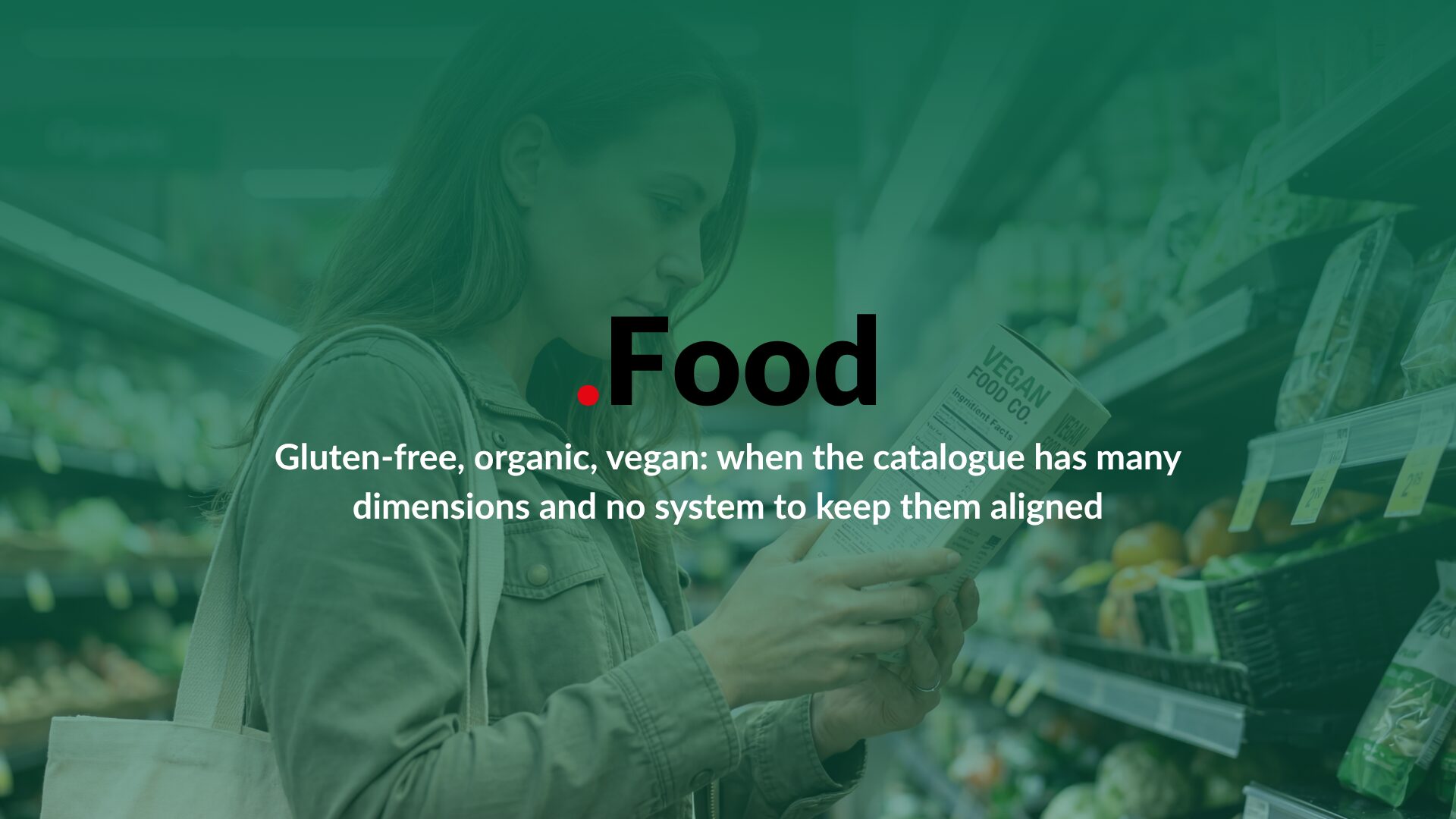
Anyone working with specialist products knows that the more carefully a product is designed (with selected ingredients, precise certifications and verified claims) the harder it becomes to manage the information that describes it with the same level of care.
The number of steps and people involved in keeping this information aligned makes the task complex, however much attention is paid to it.
A company producing gluten-free pasta, organic lines or vegan variants has to manage a different set of information for every product: AIC-certified ingredients, organic claims verified by the certification body, validated vegan indications, allergens updated in line with European regulations, and translations for each foreign market.
And this is repeated for every SKU in the catalogue, which often includes hundreds of products.
Product data originates in R&D, where the recipe and technical specifications are defined. From there, it begins a journey across different departments: marketing turns it into claims and packaging, quality verifies the certifications, export adapts it for each market, sales reps use it during customer visits, grocery retail buyers enter it into their systems, and the B2B portal displays it to the end customer.
At each step, something can be lost or become misaligned: an allergen not updated after a supplier change, an organic claim remaining on an old product sheet, or an expired certification. These misalignments directly affect legal and reputational aspects, not just operational ones.
When product information is spread across ERP systems, Excel files, PDFs and shared folders, the risk of misalignment grows with the number of channels and markets to manage. A grocery retail buyer asks for the latest technical sheet, and someone has to collect it from different sources, check it and format it as required by the retailer.
When certifications have expiry dates, claims need to be verified and end consumers are often highly attentive, incorrect information can be costly. A product sheet with an incorrect allergen can generate complaints, returns and, in the most serious cases, legal consequences.
Whit the .one PIM Product Information Management solution, product information is managed in a single system, structured to handle the complexity of specialist products: certifications with expiry dates and update workflows, claims that can be verified by channel and market, allergens tracked and updated in real time, and translations managed centrally.
When an ingredient, supplier or certification changes,the update is made from a single point and automatically distributed to sales reps, the B2B portal, grocery retail buyers and digital channels, without having to chase emails or update files one by one.