What we learned from building our Chatbots
10/05/2024

Are you thinking about implementing a corporate training service or offering quick answers via a Service Desk?
There’s an ideal solution: the Chatbot — an assistant capable of delivering accurate answers thanks to semantic search.
There are plenty of tools online that claim to let you build a chatbot in just a few minutes, but is it really that simple to develop one that actually works? Let’s find out together!
While building a chatbot, we realised that documentation can be an obstacle—both during the creation phase and when it comes to user experience.
Creating documentation is a company-wide issue, and it’s not always handled consistently. More often than not, documents are written in a highly personal style, based on the assumption that the reader already understands the subject.
Accessing and using documentation is just as complex, as searches often return multiple documents, forcing the user to sift through them to find the right answer.
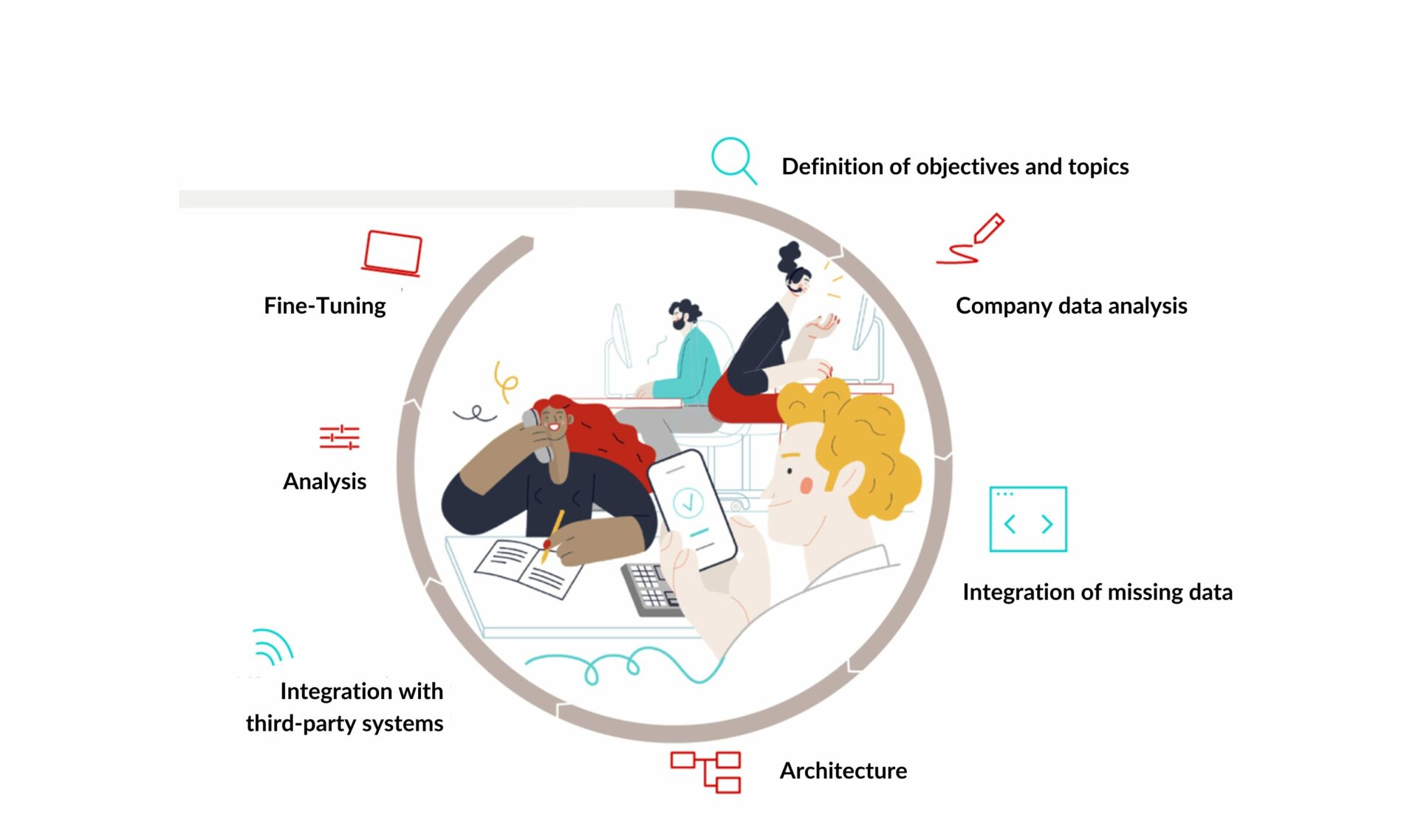
Building a Chatbot involves several crucial stages that ultimately determine its effectiveness. Below is a list of the key phases:
The creation of a Chatbot—its architecture, the design of its flows, and more—requires solid experience and strong process expertise. Being supported by someone who has already tested and implemented a Chatbot in real-world scenarios, and who can offer ongoing support, significantly increases both its reliability and performance. After all, the Chatbot is often the only—or at least the most important—entry point for user requests, so the reliability of its responses is absolutely critical.
Artificial Intelligence is making huge strides. New models are emerging, others are rapidly evolving, and LLMs are now available to help boost performance. In parallel, new techniques are enabling increasingly accurate and refined results.
At Aton, we believe the best way to recommend a solution is to try it ourselves first.
That’s why we created a series of Chatbots designed to support our colleagues in the International Service Desk team.
Their purpose is to assist the Retail division by enabling quick access to documentation and helping provide timely answers to users.
The experience we’re gaining allows us to ensure service continuity by sharing knowledge across different teams — not bad, right?
To wrap up, using a Chatbot in the delivery of our services has taught us a few things we didn’t expect — and we’d be happy to share them over a coffee!
In the coming weeks, the Atonpeople working in User Support will share their journey from a User Experience perspective — so stay tuned to find out more!